W26 @ Valency
In the Winter of 2026, I had the opportunity to work on the development team at Valency Inc. In this report, I will give an overview of the work I accomplished and reflect on the key takeaways from this experience.
In the Winter of 2026, I had the opportunity to work on the development team at Valency Inc. In this report, I will give an overview of the work I accomplished and reflect on the key takeaways from this experience.
Valency is a business to business software company specializing in project assurance for capital projects. The goal of project
assurance is to provide a company with confidence and predictability on whether a project will remain viable. Valency's key
area of focus is on capital projects, which are any sort of large-scale, expensive investments that are made by a company.
Some examples of capital projects would be an oil company investing in new drilling locations, or a tech company investing in
building a new data center.
Valency sells a product called Carve which provides standardized assessments, built for different industries, to assess the
current status of a project. Carve contains a variety of assessment templates which cover all different phases of a project's
lifecycle. Along with these assessments, the Carve platform provides companies with benchmarking against both historical and industry
data. This benchmarking provides customers with an idea of where they stand against other companies in their industry.
Valency is based in Waterloo, Ontario and has existed for over 13 years. Over that lifespan the team at Valency has assessed over
68 billion dollars in project value and their customers have used the Carve platform to assess an additional 65 billion dollars
of annual capital expenditures.
Reference:
[1] Valency Inc., "About Valency," 2026. [Online]. Available: https://valencyinc.com/about . [Accessed: April 27, 2026].
At Valency, I worked on the develpment team which was responsible for improving Valency's main product, Carve.
In this 4 month term, my primary tasks were: developing an end-to-end automated test suite and the deployment of a new
self-paced training site.
To develop an end-to-end test suite, I utilized Playwright, which is an open source framework developed by Microsoft used
for cross-browser automation and web application testing. Using the Playwright framework, I set up over 40 automated "smoke
tests" written in JavaScript which were divided into a light suite and a heavy suite. The light suite of tests covered the
main workflows in Carve, particularly conducting each major type of assessment. The heavy suite included tests that ran for each
of the 5 user types that exist in Carve.
While developing these test cases I had a couple main takeaways:
Locally I would have a test case that seemed to work flawlessly, never running into any issues. But as soon as the same test ran in our development environment things behaved differently. I learned that local environments often hide race conditions because they don't have to deal with the same sort of network latency and resource constraints of an application deployed on the internet. This taught me how important it is to build redundancy into software to handle the realities of production software.
My initial approach to developing these test cases was that I wanted to get a proof of concept test case complete as quickly as possible. I put together a series of instructions and very quickly I came to realize how much duplicate code was being created. Rather than powering through, I took time to refactor my approach splitting components of tests into classes and their respective functions. This approach was much easier to maintain and further test case implementations became much easier as I already had some of the baseline functions complete for parts of shared workflows.
The other project that I worked on this term was deploying an external LMS (Learning Management System) to host new training content.
This project involved determining which LMS we wanted to use, I investigated different options before deciding on utilizing Moodle,
an open source LMS that we could customize exactly to meet our needs.
Along with the deployment of this LMS, I also took over the development of our integration with a platform called HeyGen to generate customized
training videos using generative AI. In our application, we configured around 70 different variables of common industry concepts and we
allowed customers to edit those variables to align with the terms that they use when describing those concepts. This ensured that the content
we delivered aligned with each customer's required personalizations and that our content was dynamic and could be easily adjusted in the future
to adapt to future industry trends in the area of project assurance.
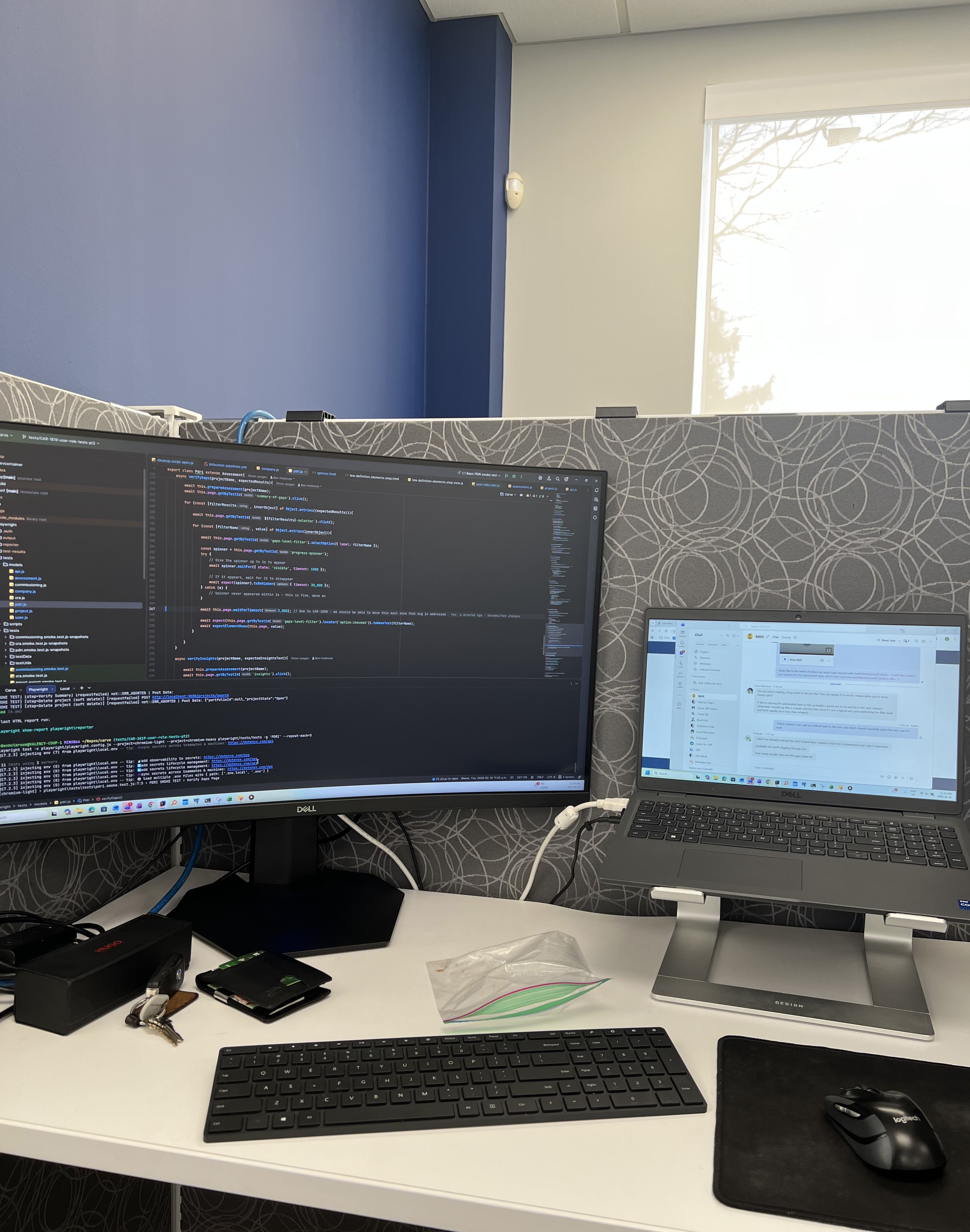
An image of my desk in the Valency Office
During my term, I gained valuable DevOps experience through taking part in 2 major releases for our application, Carve, and through learning how to deploy an open source Learning Management System (LMS). I learned about how deployments are managed in Heroku and had hands-on experience deploying our LMS with a platform called Northflank.
To meet this goal I made a point to maintain regular contact with my team, updating them on the work I was completing and also asking questions right away once I had determined that something was a blocker for myself. I had opportunities to do this due to my in-person working arrangement as our development team all worked out of the same room and additionally I was able to give more formal updates in weekly one-on-one meetings with my supervisor and weekly sprint planning meetings.
In this term our team used Jira to manage outstanding tasks and I had the opportunity to continue to learn that software and how to navigate around Jira to understand and prioritize my assigned tasks. When I had large chunks of work to complete, I would break down the task into smaller sections and write down each step to keep myself organized and for more conceptual tasks I organized my thoughts on an online mind-map so I could visualize which parts of a given workflow I needed to make updates to.
To conclude, this experience at Valency has been an excellent stepping stone for me as I look to build up my career as a Software Engineer. I really enjoyed working with the entire team at Valency and feel proud of the work that we were able to accomplish this term. This term has validated to me how rewarding the problem solving and creative side of software engineering can be. My work days have flown by, and I end each day excited about what we are building. I am grateful that I will get to continue in this role for another semester and continue to make an impact in this exciting role.
I would like to give a big thank you to my supervisor Brad for his mentorship throughout this role. Brad is a strong leader
who juggles a lot during the work day, but I never felt like I was on my own and always was able to seek advice when needed.
Working under Brad I felt trusted to get work done and that the work I was doing was meaningful and making an impact for our
team.
I would also like to acknowledge the rest of the development team, Eli and Erica for their help with my initial learning of
the product and how our software (Carve) worked. They were always willing to lend a hand and explain any sort of concept to
me
Finally, I would like to thank the whole team at Valency who has created such a welcoming and healthy work environment. I have
seen great examples of people who are dedicated and work hard but who also want everyone around them to succeed. I am truly thankful
that I have gotten the chance to work with each of these team members.